Read-Aloud & Discussion Guide
Guide your class, therapy group, or individual clients through Bailey’s Body Alarm with ease. This practical discussion tool helps children recognize nervous system responses and discuss emotional regulation safely—without placing pressure on any single child to disclose personal experiences.
Best For: Group storytime, classroom discussions, and guided reflection.
Key Feature: Low-pressure, trauma-informed prompt framework.
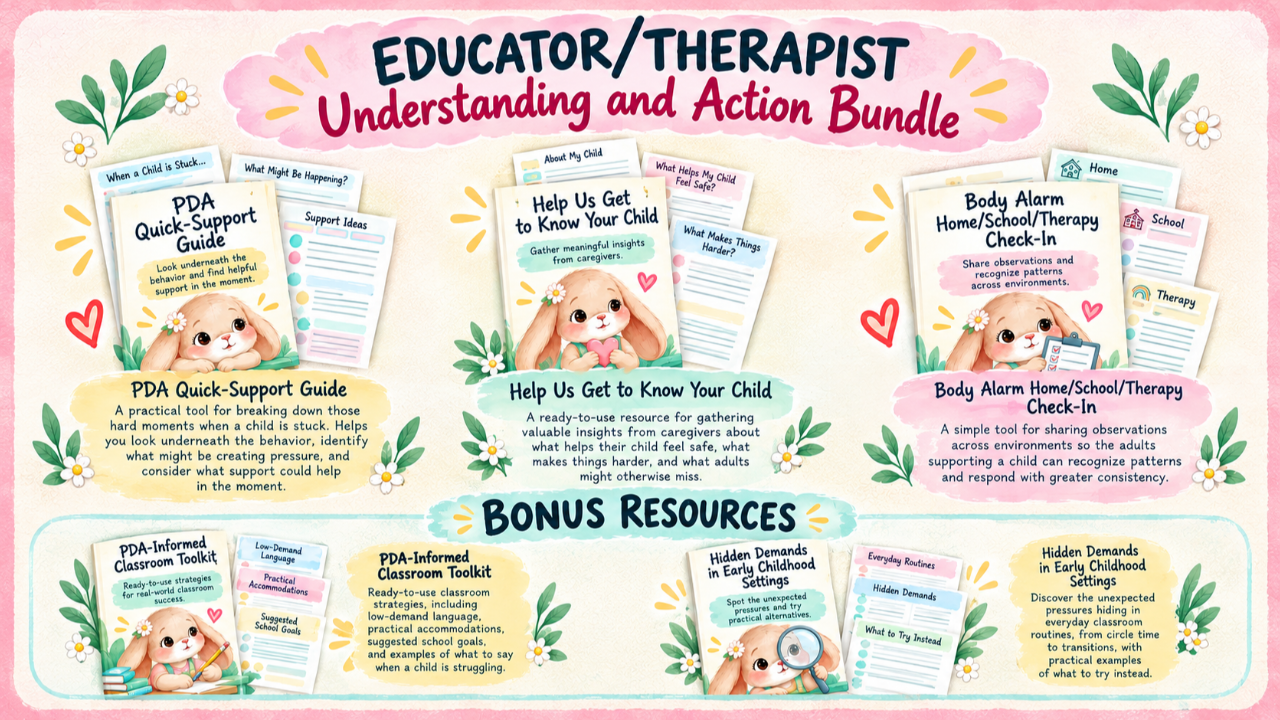
PDA-Informed Classroom Toolkit & Hidden Demands Guide
Transform how you support demand-avoidant and neurodivergent learners. This dual-resource set provides immediate, high-impact language shifts, accommodations, and practical strategies to reduce friction. Learn how to spot invisible triggers hidden inside routine moments like transitions, cleanup, circle time, and unexpected schedule changes.
Best For: Educators, school staff, and neurodiversity-affirming professionals.
Key Feature: Actionable language swaps and environmental risk-mapping for hidden demands.
Help Us Understand Your Child’s Body Alarm
Bridge the gap between home and care settings when supporting a child with PDA or a sensitive nervous system. This intake-style tool gives families an effortless way to map out known regulation patterns, triggers, and calming strategies—saving you time and helping you build on existing insights from day one.
Best For: Intake, individual support planning, and initial parent-professional consultation.
Key Feature: Structured family-collaboration template.
PDA Quick-Support Guide
Your go-to emergency playbook when routine strategies aren't working. Simply look up the specific situation or dysregulation moment you are facing to get immediate clarity on underlying nervous system drivers, environment adjustments, and real-time trial steps to restore calm.
Best For: On-the-spot troubleshooting and real-time crisis de-escalation.
Key Feature: Direct scenario-to-solution layout.
Body Alarm Check-In
Keep every adult in a child's support network on the same page. Designed for quick, clear communication between caregivers, teachers, and therapists, this template makes it easy to track behavioral observations, note successful co-regulation techniques, and share updates across settings seamlessly.
Best For: Ongoing multi-disciplinary care, daily home-school notes, and team alignment.
Key Feature: Fast, structured cross-team communication sheet.